
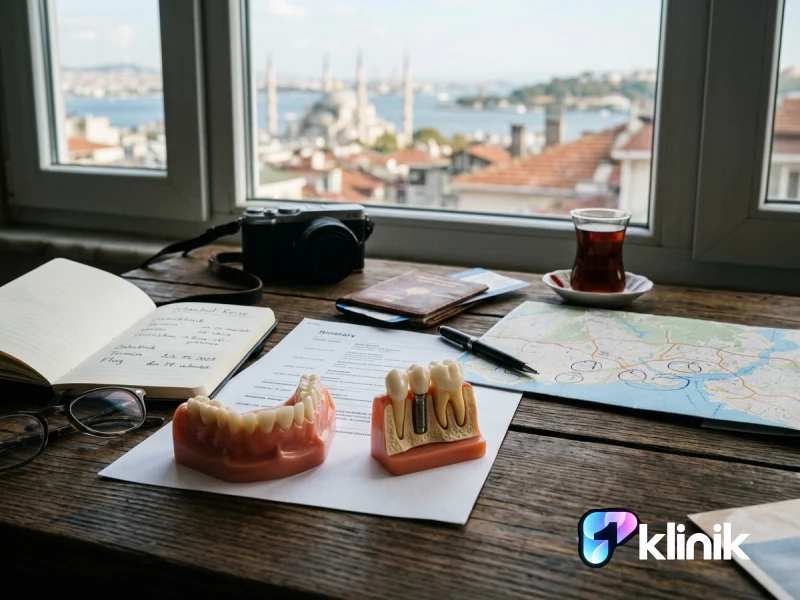
Dental bridge or implant: Both options can replace missing teeth and improve chewing as well as aesthetics. However, they differ in how they are fixed, the required prerequisites, and how the treatment proceeds. Which solution is appropriate for you depends, among other things, on the neighboring teeth, the jawbone, your overall health and your expectations. If you are planning dental treatment in Istanbul, travel organization and long‑term follow‑up are also part of the decision.
Dental bridges and implants: the basic difference
A dental bridge closes a gap using an artificial tooth that is supported by neighboring teeth. In a conventional bridge, these abutment teeth are prepared and crowned. A bridge can also replace several missing teeth, provided the supporting teeth are sufficiently robust.
An dental implant is an artificial tooth root, usually made of titanium, that is surgically placed into the jawbone. A crown is attached to it via an abutment. Implants can also support bridges or removable dentures.
For more information, see our treatment options. Also discover our clinics and our medical team.
Healthy neighboring teeth and jawbone as decision criteria
When a bridge is considered
If the neighboring teeth are already heavily filled or already require crowns, a bridge can be a sensible solution. With largely healthy neighboring teeth, the loss of tooth structure is a more significant drawback. The stability of the tooth roots and the condition of the gums also need to be evaluated.
Requirements for an implant
An implant requires sufficient supporting bone and healthy or treated gum conditions. If bone is lacking, a bone augmentation may be necessary. Smoking, poorly controlled diabetes, and existing periodontitis can increase the risk of complications. Therefore, an individual examination is essential.
Treatment process and duration compared
A conventional bridge can often be fabricated within a few appointments over several weeks. After tooth preparation, a provisional restoration initially protects the teeth. Then the fit, bite and appearance are checked before the final placement.
Implant treatment usually takes several months overall. After placement, the implant typically needs time to heal. Additional bone augmentation can extend the treatment. Immediate loading is only possible under certain conditions and does not automatically mean that the prosthesis is fully load‑bearing right away.
Risks and limitations of both options
With bridges, issues such as caries at the crown margins, gum problems, or damage to the tooth nerve can occur. Occasionally a root‑channel treatment becomes necessary later. If an abutment tooth fails, it can affect the entire bridge.
Implantations involve surgical risks such as bleeding, infections and injury to neighboring structures. Depending on the position, nerves or the maxillary sinus may be affected. In the long term, peri‑implantitis—an inflammation with bone loss around the implant—can lead to implant loss. No treatment is guaranteed for life.
Alternatives and information before decision
Depending on the findings, a resin‑bonded bridge, removable denture or orthodontic space closure may be appropriate. In selected cases, a gap can be monitored initially. Function, tooth position and personal load are decisive.
Before your informed consent, the diagnosis, treatment alternatives, necessary procedures, risks and estimated total costs should be explained clearly. Request a written treatment plan and clarify any possible follow‑up costs in case of complications.
Dental treatment in Istanbul: plan travel and follow‑up
Allow sufficient time for examination, treatment and check‑ups before returning home. Especially after surgical procedures, the appropriate travel timing depends on the individual healing course. A tightly scheduled stay can make necessary adjustments more difficult.
Clarify in advance who will treat any problems after your return to Germany. For both options, careful daily cleaning and regular check‑ups are important. If swelling increases, fever, persistent bleeding or severe pain occur, you need prompt dental care. Take your findings, radiographs and, for implants, the implant card home with you.
Cost comparison: Which services should be included in the offer
For a meaningful cost comparison between a dental bridge and an implant you need detailed quotes. A advertised implant service may only include the implant body; the abutment, crown or provisional prosthesis may be billed separately. For bridges, factors such as the number of replaced teeth and the material used affect the effort.
Also verify whether anesthesia, laboratory fees and required pre‑treatments are included. Travel, accommodation and possible additional stays belong in your personal calculation. A low initial price alone does not indicate the total expense.
Include health insurance and supplemental coverage in advance
Statutory health insurance in Germany generally contributes to dental prostheses through condition‑related fixed allowances. However, this does not mean that a planned treatment in Turkey will automatically be reimbursed. Specific requirements apply for cost coverage, which you should clarify in writing before treatment starts with your insurer.
Private health insurers and supplemental dental policies may also impose restrictions on overseas treatments. Submit the specific treatment plan and ask for required approvals, billing details and translations. Rely on the definitive information from your insurer for reimbursement questions.
Material choice: compare ceramic and metal specifically
Assess aesthetics and strength together
Different materials are suitable for bridges and implant‑supported crowns, such as zirconia, other dental ceramics or metal‑ceramic. The choice depends on the position, space, span and chewing load. In the visible area, translucency and the gum line are especially important.
Full ceramic is not a uniform material group with identical properties. Therefore ask for the exact material designation and its suitability for your case. Known allergies and sensitivities should be discussed already in the initial consultation.
Bruxism and bite influence planning
People who clench or grind at night place greater stress on prostheses and supporting structures. This can promote, for example, ceramic chipping or technical problems with implant superstructures. Signs include worn tooth surfaces, tense masticatory muscles or repeated damage to existing restorations.
Before the final restoration, the clinic should assess your bite relationship. A custom‑made occlusal splint can be useful for protection, but it does not reliably eliminate grinding. The splint also requires checks, especially if the prosthesis changes.
Cleaning under bridges and around implant crowns
Select aids appropriate to the construction
Standard toothbrushes can only reach the mucosal contact area under a bridge pontic. Depending on the design, special floss with a threader or suitable interdental brushes help. Have the clinician demonstrate the technique on your restoration so that sensitive areas are not injured.
For implant crowns, the margins to the gum must remain accessible. The appropriate size of an interdental brush should be determined professionally. An oral irrigator can supplement cleaning but does not fully replace mechanical removal of firmly attached plaque.
Documentation and agreements for later repairs
For future work, in addition to the implant card, detailed information about the manufacturer, implant system, abutment and the placed crown is helpful. For bridges, material specifications and laboratory records facilitate assessment. Request clear copies of your treatment documentation from the clinic.
Also have in writing how the clinic handles loosening, material damage or required remakes. Key points are responsibilities, time frames and who bears additional travel or laboratory costs. A contractual guarantee outlines specific services; it does not promise a complication‑free biological course and does not replace an individual assessment of the damage.
Front tooth or back tooth: the location of the gap matters
In the anterior region, natural‑looking results depend heavily on the gum contour and the small gingival triangles between teeth. After a tooth loss, these structures can change. Even a color‑matched crown may then appear longer than the adjacent tooth.
In the posterior area, chewing function and available support are often the priority. If the last tooth of a dental arch is missing, there is no abutment behind the gap for a conventional bridge. A cantilever bridge is only suitable in carefully selected cases.
Diagnostics: When three‑dimensional imaging is useful
Planning starts with a clinical examination and appropriate radiographs. A digital volumetric tomography (DVT) can provide additional spatial information,
 Dental tourismDental treatment in Istanbul: Healing and return
 Aesthetic DentistryTeeth whitening or veneers: Which solution fits?
 Aesthetic DentistryHollywood Smile: Natural Aesthetics and Veneers