
Teeth whitening or veneers: Which solution fits depends on whether you only want a lighter tooth color or also wish to change shape, position, and surface. For healthy, naturally shaped teeth, bleaching is often the gentler entry. Veneers can enable additional aesthetic changes but require careful consideration. If you are planning a treatment in Istanbul, travel time, understandable information, and follow‑up care in Germany also belong to the decision.
Teeth whitening and veneers: the main differences
In a teeth whitening procedure, pigments in the natural tooth are lightened using peroxide‑based agents. Tooth shape and position remain unchanged. Existing fillings, crowns, and veneers are not lightened by this.
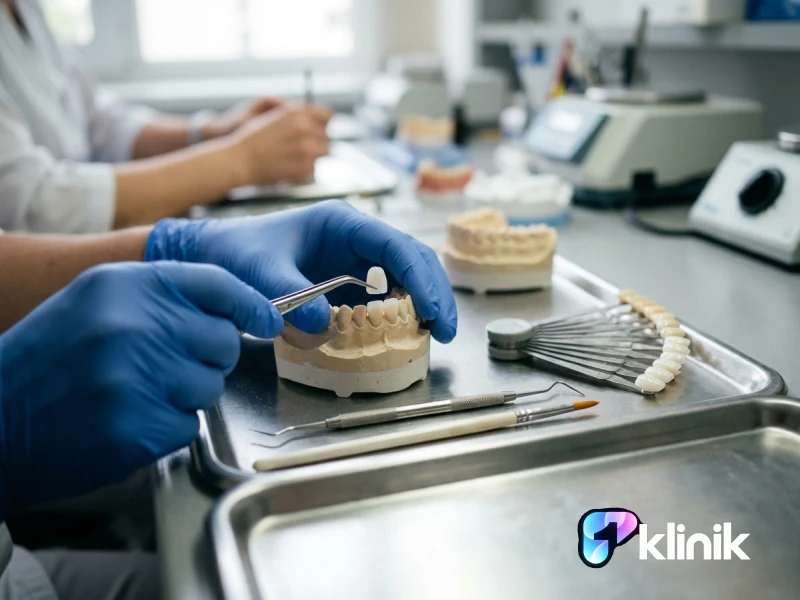
Veneers are thin covering shells, usually made of ceramic, that are bonded to the visible tooth surface. They can change color and shape as well as mask small gaps. This often requires removal of tooth enamel, a step that cannot be undone.
For more information, see our treatment options. Also explore our clinics and our medical team.
When teeth whitening may be appropriate
Bleaching is primarily considered when your natural teeth are healthy and you generally like their shape. Yellowish discolorations often respond better than certain gray or deep‑lying color changes. The achievable result, however, cannot be reliably predicted.
Professional cleaning as a possible first step
Surface deposits from coffee, tea, or tobacco can often be partially removed by a professional dental cleaning. Therefore, before deciding, it should be checked whether a cleaning already sufficiently addresses your concern.
When veneers may be a suitable option
Veneers can be considered for pronounced discolorations that are difficult to affect with bleaching, minor shape deviations, or selected enamel defects. Requirements include, among others, sufficient suitable tooth substance, healthy gums, and a functionally appropriate bite.
In cases of severe teeth grinding, larger misalignments, or extensive tooth damage, another treatment may be more appropriate. So‑called non‑prep veneers without grinding are suitable only for selected situations; otherwise the teeth can appear unnaturally bulky.
Risks and limitations of both procedures
After bleaching, teeth may temporarily become sensitive. Gum irritation is also possible, especially with improper use. Caries, leaking fillings, or exposed tooth necks must be evaluated beforehand.
For veneers, chipping, debonding, marginal discoloration, and caries at the margins are possible problems. After grinding, sensitivities can arise; rarely a root canal treatment becomes necessary. Veneers do not last indefinitely and may later require repair or replacement.
Alternatives before a final decision
Depending on the initial findings, composite build‑ups, orthodontic treatment, or a combination of various measures may also be considered. Smaller shape corrections can sometimes be achieved with directly applied composite. However, this material can discolor or wear over time.
A crown typically requires considerably more tooth structure removal than a veneer and needs an appropriate medical justification. Also, opting out of an aesthetic treatment is a legitimate decision.
Treatment in Istanbul: information and travel planning
Photos only allow a preliminary assessment. A reliable recommendation requires a personal examination; X‑rays are useful only when indicated. Have the scope of treatment, alternatives, risks, and total costs explained to you in writing and in understandable language.
For your informed consent you need sufficient reflection time before an irreversible procedure. Plan the examination, possible pre‑treatments, try‑ins, and follow‑ups with a time buffer. A tight vacation schedule should not shorten medically necessary steps.
Organize post‑treatment care before departure
Clarify in advance who is reachable for pain, detached veneers, or bite problems and how a check‑up in Germany will be organized. Request findings, material specifications, and a treatment report. Good oral hygiene, regular check‑ups, and, if necessary, a custom‑fitted night guard support long‑term maintenance.
Select bleaching method according to lifestyle and findings
During in‑office whitening, the treatment team protects the soft tissues and applies the bleaching agent in a controlled manner. For dentist‑supervised at‑home bleaching, you use custom‑made trays according to a defined application schedule. Both approaches require appropriate dosage and monitoring.
Additional light activation is not a reliable quality indicator. What matters are the suitable preparation, its application, and your initial findings. Over‑the‑counter products differ in composition and effect; acidic home remedies or highly abrasive powders can damage the tooth surface.
Investigate a single dark tooth separately
If only one tooth stands out markedly from its neighbors, the cause should first be clarified. After an injury or a root canal treatment, a tooth can discolor from the inside. Conventional whitening of the whole dental arch may not resolve this issue.
For a tooth that has already undergone root canal treatment, an internal bleaching may be considered under certain conditions. The root filling and seal are examined for this. A rare but significant risk is the loss of hard tooth substance in the root area.
Test tooth color and proportions in advance
Standardized photos and a shade match under appropriate lighting help with a traceable color plan. Directly after bleaching, teeth may appear lighter due to temporary dehydration. Therefore, the final assessment should be made only after an adequate stabilization period.
Mock‑up trial for planned veneers
A mock‑up transfers the planned tooth shape into the mouth on a trial basis. This allows better assessment of length, lip contact, and pronunciation than a digital preview alone. Such a preview remains a planning aid; it does not guarantee an exact match with the final result.
Coordinate bleaching and veneers sensibly
If some teeth are to receive veneers while the others are to be whitened, bleaching is usually performed first. Then the ceramic shade is adjusted to the stabilized tooth color. This avoids that already fabricated veneers appear too dark after whitening.
Additionally, an adequate waiting period between bleaching and adhesive bonding is required because residual bleaching agents can affect adhesion. The specific interval is determined by the treating practice according to the procedure. An immediate definitive restoration within a few vacation days may therefore be unsuitable.
Compare offers based on specific services
A meaningful cost estimate lists the affected teeth, the planned procedure, and the included services. For veneers, laboratory work, temporaries, and possible adjustments should also be clearly described. Check which costs may arise from a plan change or an additional trip.
- Who is responsible for the treatment and who manufactures the dental prosthesis?
- Which services are billed for necessary corrections?
- What payment terms apply in case of a treatment termination?
Purely aesthetic procedures are usually not covered by German statutory health insurance. Any possible reimbursement should be clarified directly with your insurer before booking.
Interpret post‑treatment complaints correctly
Mild, short‑term sensitivity after bleaching can often be alleviated by pausing the application and using appropriate care. Coordinate this approach with the practice. Increasing or sudden pain, swelling, and fever, however, require prompt dental examination.
If a tooth feels pressured when biting after veneers, the bite should be checked. Do not attempt to grind the surface yourself or attach a detached shell with household glue.
Enamel as the basis for veneer bonding
The durability of a ceramic veneer depends on what it is bonded to. Bonding to healthy enamel provides especially favorable conditions. If large portions of the intended bonding area lie on underlying dentin or older fillings, the restoration becomes more demanding.
Therefore, the planned preparation deserves special attention: How much enamel can be preserved, and which existing defects affect adhesion? A very thin ceramic shell alone is not proof of a substance‑conserving treatment. The required space creation also plays a role.
Consider gum contour and visible tooth necks
The effect of a smile also depends on the gums. Varying gum heights or exposed root surfaces can only be limitedly influenced by a color change. Root surfaces also react differently to bleaching agents than the enamel‑covered crown.
If the gums recede later, transitions between the veneer and the tooth can become visible. A planned gum correction requires its own diagnosis and explanation. It should not be casually included as part of an aesthetic overall package.
Plan especially long‑term for younger patients
In adolescents, tooth position, gum contour, and jaw development are still changing. Early irreversible treatment can therefore lead to repeated interventions over many decades. For purely aesthetic concerns, a conservative approach is especially important.
In the EU, tooth whitening agents containing more than 0.1 % up to a maximum of six percent hydrogen peroxide may not be used on persons under 18 years of age. For treatment in Turkey, you should explicitly clarify the applicable regulations there; differing rules do not
 Dental tourismDental treatment in Istanbul: Healing and return
 Dental prostheticsDental bridges and implants compared
 Aesthetic DentistryHollywood Smile: Natural Aesthetics and Veneers